




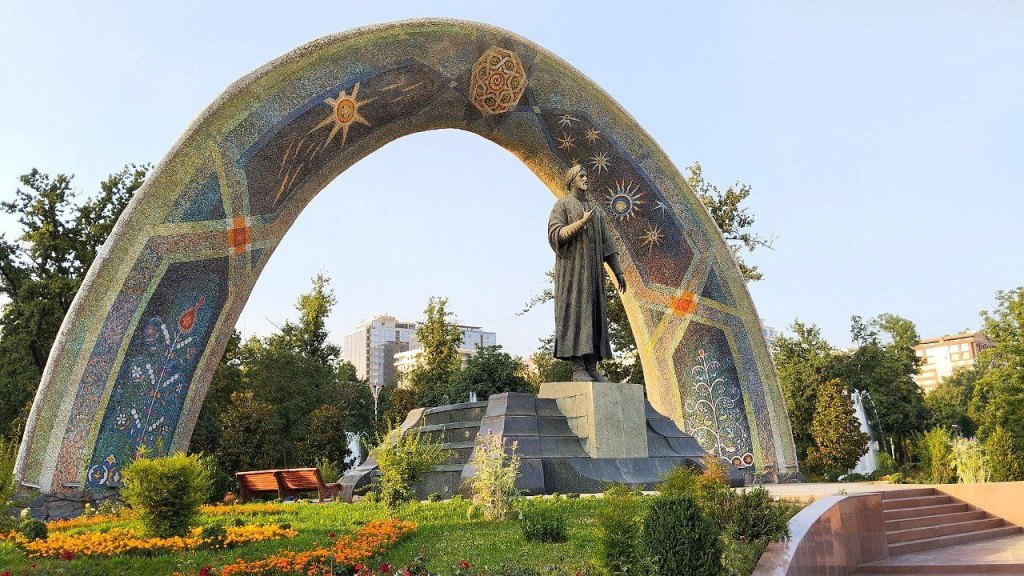
Every year on September 22, Tajikistan celebrates Roudaki Day in honor of Abu Abdallah Roudaki, the great poet and founder of Tajik-Persian classical literature. To mark the occasion, Asia-Plus has compiled a collection of photos of Roudaki monuments located in Tajikistan and across the globe.
In Tajikistan, Roudaki’s legacy is immortalized through numerous statues and busts across the country. The capital city of Dushanbe alone is home to at least four monuments dedicated to the poet — prominently placed in Ustod Roudaki Park, the State Flag Park, Roudaki Square, and on the façade of the Union of Writers of Tajikistan. His busts also stand before the National Library, the Behzod Museum, and various academic and literary institutions.
Outside Dushanbe, Roudaki’s likeness can be found in cities like Bokhtar, Khujand, Istaravshan, Panjakent, and Isfara, reflecting the poet’s widespread cultural significance across the country.
But Roudaki’s influence extends far beyond Tajikistan’s borders. Monuments to the revered Tajik-Persian poet have also been erected in countries such as Iran, Russia, and China — a testament to his enduring impact on Persian literary traditions.
In 2008, under the initiative of Tajik President Emomali Rahmon, UNESCO commemorated the 1150th anniversary of Roudaki’s birth. The celebration included international academic conferences and cultural events held in cities such as Dushanbe, Moscow, New York, Berlin, Tehran, Kabul, and Istanbul.
Abu Abdullah Jafar ibn Muḥammad Roudaki (858-940/941 AD) was born in the village of Panjroud, Panjakent district of the modern Republic of Tajikistan.
Roudaki was a poet, singer, and musician who is regarded as the first major poet to write in New Persian. A court poet under the Samanids, he reportedly composed more than 180,000 verses, yet only a small portion of his work has survived, most notably parts of his versification of the Kalila wa Dimna, a collection of Indian fables.
The important part of Roudaki's career was spent at the court of the Samanids. While biographical information connects him to the Samanid amir (ruler) Nasr II (r. 914–943), he may have already joined the court under the latter's predecessor, Ahmad Samani (r. 907–914).
Roudaki's success was largely due to the support of his primary patron, the vizier Abul-Fazl al-Balami (died 940), who played an important role in the blooming of New Persian literature in the 10th-century. Following the downfall of Balami in 937, Roudaki's career deteriorated, eventually being dismissed from the court. He thereafter lived his last years in poverty, dying blind and alone in his hometown.
In Iran, Roudaki is acknowledged as the "founder of New Persian poetry" and in Tajikistan as the "father of Tajik literature".
 Руcский
