




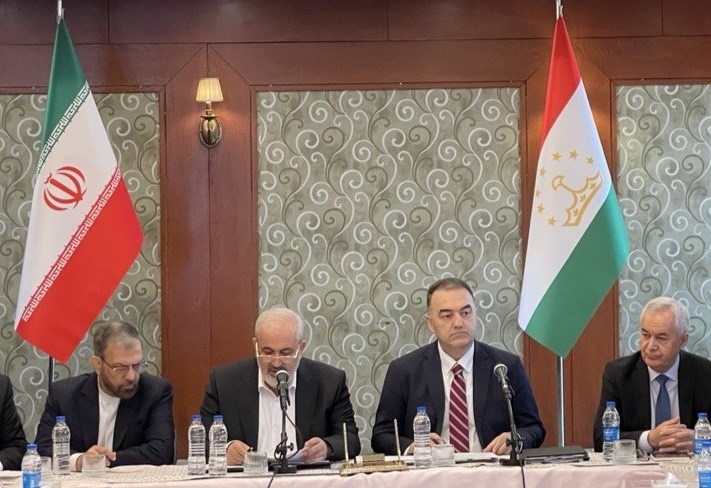
Co-chaired by the Tajik Minister of Energy and Water Resources Daler Juma and his Iranian counterpart Abbas Aliabadi, the two-day 17th meeting of the Joint Intergovernmental Commission for Trade and Economic Cooperation took place in the Iranian city of Shiraz on May 5-6.
The agenda of the 17th meeting of the joint intergovernmental commission included several parts: meetings of experts from organizations and ministries that have been developing memorandums for several months, as well as a final meeting where changes will be made if necessary.
The second part of the meeting included a business session between entrepreneurs from Tajikistan and Iran. This meeting involved 25 Tajik and over 30 Iranian entrepreneurs and industrialists.
Daler Juma described the session as a milestone in strengthening bilateral relations. He noted that a two-way trade volume between the two countries reached US$377.7 million last year — a 48.4% increase compared to 2023. Over the first quarter of 2025, the bilateral trade has reportedly risen 42.9%, reaching US$110.6 million.
Iran’s Mehr News Agency (MNA) reports that Daler Juma announced that the two-way trade between the two countries is expected to grow to half a billion dollars. He reportedly also mentioned plans to increase direct flights to Iran and to remove visa requirements between the two countries.
A key outcome of the meeting was the signing of several memorandums of understanding across a wide range of areas, including investment, free trade zones, standardization, agriculture, science, culture, etc.
One of the central agreements was a memorandum of understanding (MoU) between the National Standards Organization of Iran and the Agency for Standardization of Tajikistan, aimed at improving product and service quality in both countries.
IRNA says the parties signed a MoU on cooperation in fishery.
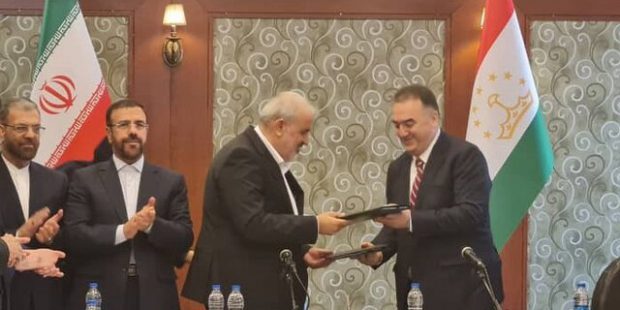
Iran’s Minister of Energy, Abbas Aliabadi, emphasized that the signed memorandums are intended to foster mutually beneficial projects — including joint ventures in crafts and textiles, as well as support for entrepreneurship.
Aliabadi added that these documents would lay the groundwork for expanding cooperation, particularly in technical and engineering services.
The parties reportedly agreed to establish working groups to monitor and implement the signed agreements.
Tajikistan’s Minister of Energy and Water Resources expressed confidence that the memorandums and agreements would serve as a strong foundation for future cooperation.
“We expect these steps to lead to sustainable economic development and stronger ties between our countries,” he said.

According to a press release from Tajikistan’s Ministry of Energy and Water Resources (MoEWR), economic cooperation between the two countries have been steadily improving in recent years, opening new avenues for cooperation in energy, transportation, geology, and water resources.
The signing of the final protocol of the meeting on May 6, 2025, is expected to formalize the agreements and outline future directions for expanded cooperation.
Key goals include deepening trade relations, developing infrastructure, increasing mutual investment, and continuing cultural exchanges.

Asia-Plus editor wins award for civic engagement in journalism
2025 becomes the second-hottest year on record
Tajikistan develops a new long-term power system plan for GBAO for the period up to 2050
Zelensky signals readiness for elections within 60–90 days if U.S. ensures security
Young lawyers in Tajikistan learn to defend the rights of violence victims
67 journalists killed worldwide in 2025, RSF reports
Uzbekistan’s solar and wind power output reportedly hits 10 billion kWh, saving billions of cubic meters of gas
Emomali Rahmon inaugurates new factory and educational institutions in Tursunzoda
Traffic jams in Dushanbe: a result of urban planning failures
One year without Assad: what has changed in Syria
All news
Авторизуйтесь, пожалуйста