




The Asian Development Bank (ADB) is trimming its growth outlook for developing Asia and the Pacific by 0.1 and 0.2 percentage points for this year and next, respectively, amid the emergence of a new global trade environment, shaped by tariffs and updated trade agreements.
Economies in the region are projected to grow by 4.8% this year and 4.5% next year, according to Asian Development Outlook (ADO) September 2025, released on September 30. This compares with April forecasts of 4.9% and 4.7%, respectively.
Higher tariffs imposed by the United States (US) and elevated trade uncertainty are expected to weigh on the region’s growth. Inflation will continue to ease to 1.7% this year amid lower prices for food and energy, before increasing modestly to 2.1% next year as food prices normalize.
The growth forecast for Caucasus and Central Asia is slightly upgraded for this year to 5.5%, while the projection for next year is trimmed by 0.1 percentage points to 4.9%, primarily due to lower oil and gas production in some countries in the subregion.
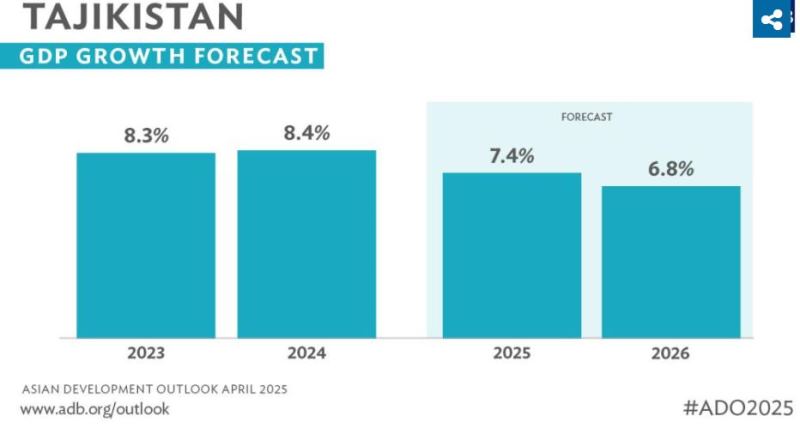
ADB is forecasting Tajikistan’s economy to grow by 7.4% this year and 6.8% next year, maintaining its projections made in April. Inflation is now projected at 4.5% this year and 5.2% next year, downward revisions compared with April’s forecasts of 5.0% this year and 5.8% next year.
The main risks to developing Asia and the Pacific’s outlook include continuing uncertainty around US trade policy, particularly regarding possible sectoral tariffs on semiconductors and pharmaceuticals, as well as unresolved US–China trade negotiations. Ongoing geopolitical tensions, potential further deterioration in China’s property market, and possible financial market volatility could also affect the region’s outlook.


US expels 2.5 million illegal immigrants in a year
Tajik health ministry confirms circulation of H3N2 flu, urges Caution but no panic
Kyrgyzstan's Constitutional Court rejects president’s proposal to reinstate death penalty
Uzbek woman sentenced in Moscow to 15 years on charges of financing terrorism
Low-quality Tajik coal, expensive Kyrgyz coal: demand surges along with prices
Members of organized gang linked to 11 Serious Crimes, including murder, detained in Dushanbe
Fintech holding OSON launches B2B platform in Tajikistan, giving banks access to payments and transfers via Unified API
Rainfall reportedly brings some relief to Tajikistan's power shortages, but Citizens say blackouts persist
China demands Taliban investigate killing of its citizens in Tajikistan
Tajikistan strengthens water resource oversight with Launch of National Water Council
All news
Авторизуйтесь, пожалуйста