




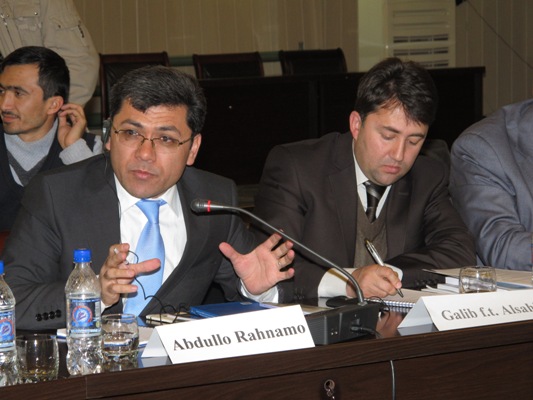
DUSHANBE, February 21, 2012, Asia-Plus – “We are frequently hear about radicalization of youth but we do not realize well what is actually going on, and we have spoken a lot about threats but we have neglected an opportunity to carry out dialogue on this theme,” German Ambassador to Tajikistan, Ms. Doris Hertrampf, noted here on February 21, inaugurating an international conference entitled “Development of Islam in Central Asia: New Trends, Problems and Solutions to Them.”
Organized by Media Group “Asia-Plus,” IslamNews.tj Project and the Friedrich Ebert Foundation, the conference brought together Tajik and foreign experts, representatives from the Committee on Religious Affairs (CRA) and Islamic organizations, as well as MPs and journalists. Representatives from diplomatic missions and international organizations active in the country have also been invited to attend the conference as guests.
The event was aimed at discussing the role of Islam in the modern Tajik society and in the future of the country. The conference was also dedicated to promote strengthening of dialogue between the state and religion.
According to German diplomat, there are no so many partners in dialogue with political Islam and Tajikistan is the only country in CIS Central Asia, where Islamic party is registered.
“Young generation is the main carrier of the future and our task is to give it as much as possible information so that the youth could form its position and its view on radicalism,” said Ms. Hertrampf. “Of course, we must speak seriously about threat of radicalism but this should not lead to violation of freedom of religion.”
Wulf Lapins, Project Coordinator of the Friedrich Ebert Foundation for Central Asia, pointed to the necessity of carrying out dialogue between secular political elite and political Islam.
Speaking at the conference, Tajik independent expert Abdullo Rahnamo, in particular, noted that the terms “Islamic factor” and “Islamization of society” became pointless in Central Asia, including Tajikistan, where the overwhelming majority of the population is Muslims.
“It is necessary to distinguish revival of Islamic values from radicalism – many confuse the notion of revival of Islamic values with strengthening of radicalism,” Rahnamo said.
At the same time, the expert considers that “excessive politicization exists in relations between the state and religion.”
Deputy of Tajikistan’s lower house (Majlisi Namoyandagon) of parliament Suhrob Sharipov also noted that politicization of the Islamic factor in Tajikistan was now at a very high level. The expert, however, considers that the return of Islamic values is a natural process “and there is nothing tragic, extremist or radical about that.”
“Transformation of power is also going on, it has not yet been completed,” said Sharipov. “The government is trying to create comfortable conditions so that Islamic factor would not affect other factors, politics, economics, etc.”


First pilot container train successfully departs from China to Tajikistan
How a Tajikistani native made his way to one of the world’s most influential tech companies
Two traders arrested on the first day of Ramadan for overcharging on meat in Dushanbe
27 young men sentenced in Tajikistan last year for avoiding military service
Uzbekistan launches jury trial system as an experiment
Job market in Tajikistan: Somon.tj identifies most in-demand professions and market trends
Russian lawmaker proposes migrants should receive benefits only after 20 years of residence in Russia
Tajikistan in 2025: economic growth, inflation, and foreign trade
Police in Dushanbe urges entrepreneurs to avoid unjustified price increases during Ramadan
"No criminal cases have been initiated": Tajikistan has not punished citizens for participation in the war in Ukraine
All news
Авторизуйтесь, пожалуйста