




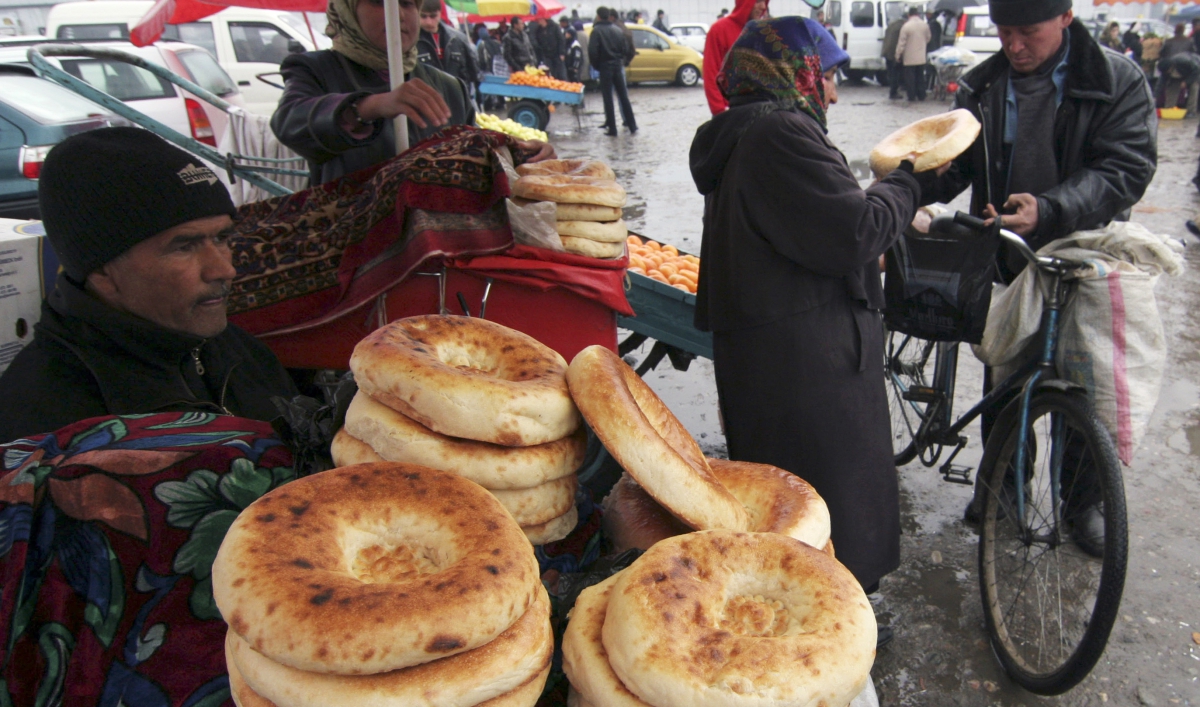
Global Finance has ranked Tajikistan among the world’s thirty-three poorest countries.
In Global Finance’s list of countries by GDP per capita, Tajikistan with its average GDP per capita for 2016 amounting to only 2,982 U.S. dollars is ranked 157th among 189 nations.
Recall, last year’s gross domestic product (GDP) of Tajikistan with a population of 8,600,000 people stood at 54.471 billion somoni (equivalent to some 7 billion U.S. dollars).
Meanwhile, Kazakhstan with its average GDP per capita for 2016 amounting to 25,669 U.S. dollars is ranked 54th; Turkmenistan (17,347 U.S. dollars) – 73rd; Uzbekistan (6,452 U.S. dollars) – 127th; and Kyrgyzstan (3,467 U.S. dollars) – 148th.
Russia with its average GDP per capita for 2016 amounting to 26,109 U.S. dollars is on the 52nd place.
Once again in 2016, all ten of the world's poorest countries are found in sub-Saharan Africa. The unenviable status of being the very poorest and least developed of them all goes again to the Central African Republic (CAR), where the citizen’s average wealth is just $659 a year. It is followed by the Democratic Republic of Congo (784 U.S. dollars) and Burundi (818 U.S. dollars)
Global Finance notes that most of the poorest countries are ruled by authoritarian regimes and, in the absence of robust judicial institutions or a free press, corruption is widespread if not endemic. These factors, together with low levels of transparency, weak financial institutions, and inadequate infrastructure have acted as a deterrent to investment.
The top ten richest countries in the world include Qatar (129,726 U.S. dollars); Luxembourg (101,936 U.S. dollars); Macao (96,147 U.S. dollars); Singapore (87,082 U.S. dollars); Brunei (79,710 U.S. dollars); Kuwait (71,263 U.S. dollars); Ireland (69,374 U.S. dollars); Norway (69,296 U.S. dollars); the United Arab Emirates (67,696 U.S. dollars); and San-Marino (64,443 U.S. dollars)
GDP per capita is the standard method of measuring how wealthy or poor a given country is compared to others countries. Essentially, it reflects the average wealth of each person resident in that country. In order to compensate for huge differences in living costs and rates of inflation—particularly necessary in countries where local currencies have lost value against the US dollar over the past 12 months—GDP per capita is adjusted to reflect PPP (purchasing power parity) so as to gain a more realistic picture of an average resident's buying power in a particular country.


President signs decree on spring conscription campaign
Flights between Tajikistan and Iran temporarily suspended
Iran’s Embassy in Dushanbe publishes Emomali Rahmon’s condolences over the death of Ayatollah Ali Khamenei
Iran’s governing council begins work after Ayatollah Khamenei’s death
Latest developments of US-Israel war on Iran
Central Asian foreign ministers meet with UK parliamentary leaders
London hosts the first UK + Central Asia ministerial meeting
WFP invites you to join its registry of suppliers of goods and services
Avalanche hazard announced in Tajikistan
U.S. and Iran hold "most serious" talks on nuclear program in Geneva
All news
Авторизуйтесь, пожалуйста