




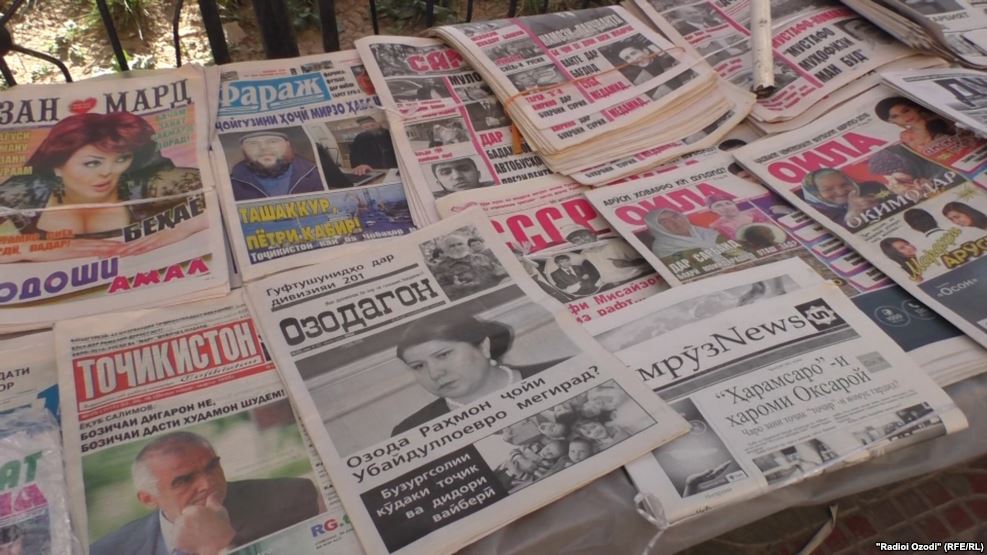
2017 World Press Index released by the press rights group Reporters Without Borders (RSF) on April 26 ranks Tajikistan 149th among 180 nations in terms of the press freedom situation.
An annual press-freedom index of the Paris-based media watchdog includes a world map in which countries are categorized by different colors depending on the situation of press freedom there: white indicates “good,” yellow “fairly good,” orange “problematic,” red “bad,” and black indicates “very bad.”
Tajikistan is among the states classified as "red" for press freedom. RSF says that “authoritarian tendencies threaten the fragile national consensus in Tajikistan.”
“On the pretext of combatting terrorism, the government has eliminated the political opposition and is building pressure on the remaining independent media. Interrogation by intelligence officers, intimidation, and blackmail have become part of the daily fare of independent journalists. Surveillance of communications is now routine, while the blocking of the main news websites and social networks is virtually permanent,” RSF said, noting that 2016 saw the closure of several independent media outlets and the adoption of a decree reinforcing state control over the editorial policies of the broadcast media.
Russia (148th), Belarus (153rd) and Kazakhstan (157th) are also among the countries where the situation for press rights is “bad.”
Meanwhile, Armenia (79th), Moldova (80th), Kyrgyzstan (89th) and Ukraine (102nd) are ranked among the index's “orange” countries, where RSF says the media-freedom situation is considered a "noticeable problem."
Turkmenistan is at the bottom of the index. It is ranked 178th -- a ranking higher than only North Korea and Eritrea.
Azerbaijan and Uzbekistan, which are ranked 162nd and 169th respectively, are also colored black on RSF's 2017 world map, meaning that the situation of press freedom in these countries is classified as “very bad.”
RSF says in its 2017 World Press Index that violations of press freedom are no longer the prerogative of authoritarian regimes and dictatorships.
It says the number of countries where the situation for media is considered "good" or "fairly good" has fallen in the span of just a year, and so-called model democracies are no exception to the trend when it comes to a worsening situation for journalists.
RSF says that the 2017 index shows the “ever darker world map” as a total of 21 countries are now colored black on the press freedom map, and 51 -- two more than the last year -- are colored red. In all, the situation has worsened in nearly two-thirds of the 180 countries covered in the index, RSF says.
The Press Freedom Index is an annual ranking of countries compiled and published by Reporters Without Borders based upon the organization's own assessment of the countries' press freedom records in the previous year. It intends to reflect the degree of freedom that journalists, news organizations, and netizens have in each country, and the efforts made by authorities to respect this freedom.
The report is partly based on a questionnaire, which asks questions about pluralism, media independence, environment and self-censorship, legislative framework, transparency, and infrastructure. The questionnaire takes account of the legal framework for the media (including penalties for press offences, the existence of a state monopoly for certain kinds of media and how the media are regulated) and the level of independence of the public media. It also includes violations of the free flow of information on the Internet. Violence against journalists, netizens, and media assistants, including abuses attributable to the state, armed militias, clandestine organizations or pressure groups, are monitored by RSF staff during the year and are also part of the final score.


Somon Air resumes flights on Dushanbe–Dubai route
Tajik tourism companies sign more than 20 agreements at ITB Berlin 2026
Tajik President Emomali Rahmon congratulates Mojtaba Khamenei on becoming Iran’s Supreme Leader
Mojtaba Khamenei chosen as Iran’s new Supreme Leader: what is known about him?
AI in Tajikistan's tax system: how technology is changing interactions with citizens and businesses
“We consider Iran’s success our success, and its failure our failure”: views of Tajikistan’s public figures on the U.S.-Israel war on Iran
More than 2.7 million Tajiks visited Uzbekistan in 2025 for tourism, medical treatment, and education
Recruitment tender
Moody’s raises Tajikistan's credit rating to "B2" with stable outlook
The Line of Durand: How far will the armed conflict between Pakistan and Afghanistan go?
All news
Авторизуйтесь, пожалуйста