




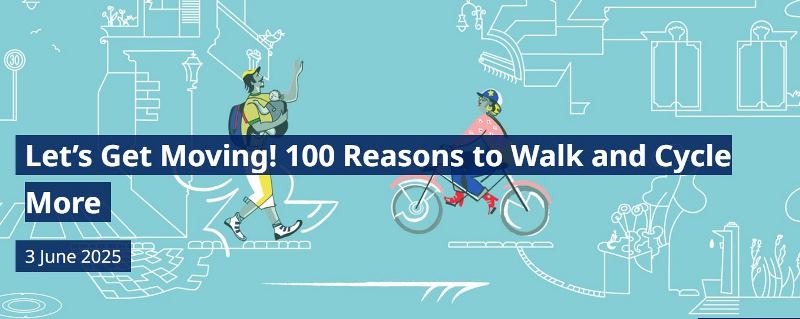
Today is World Bicycle Day and WHO/Europe is launching the campaign “Let’s Get Moving! 100 Reasons to Walk and Cycle More” under the framework of the Transport, Health and Environment Pan-European Program (THE PEP).
A statement released by WHO says insufficient physical activity remains a leading risk factor for noncommunicable diseases and premature mortality. In the WHO European Region, physical inactivity is reportedly linked to approximately 1 million deaths each year, with nearly 25% of adults failing to meet WHO’s recommendation of at least 150 minutes of moderate-intensity aerobic activity throughout the week.
WHO promotes safe walking and cycling for their significant health, environmental and societal benefits. Active mobility helps prevent major noncommunicable diseases, enhances mental well-being, reduces environmental noise, as wells as emissions of air pollutants and greenhouse gases, eases traffic congestion, makes more public space available for use by the community, and fosters safer, greener and more liveable and attractive urban environments.
The statement notes that the 1-hour launch event will feature speakers from academia, city authorities, national governments and civil society, who will share insights into the benefits of walking and cycling from their diverse perspectives.
The event is open to anyone working on transport, health, environment and urban planning for national, regional or local governments, as well as researchers, professionals and the general public.
The “Let’s Get Moving!” campaign
By showcasing 100 reasons to make walking and cycling part of daily life, the “Let’s Get Moving!” campaign aims to inspire individuals, communities and decision-makers to support and promote active mobility initiatives and encourage broad engagement and action across the Region. The campaign targets health, transport, environment and urban planning professionals, policy-makers, civil society actors and the general public. It combines the latest scientific evidence with personal experiences from across the European Region, illustrating the transformative potential of active mobility.
“By making walking and cycling safer and more accessible for all, we can create lasting positive impacts on public health, our communities and the environment, for current and future generations,” the statement says.


Who Emomali Rahmon criticized — and praised — in 2025
Trump announces plans for US ground operation against Mexican drug cartels
Emomali Rahmon shakes up police officials
Tajik citizen extradited from Azerbaijan to homeland
Tajik somoni strengthens against the dollar and the euro in 2025, weakens slightly to the Russian ruble
How Tajikistan's farmers are adapting to climate change
VIPzone winter issue: key faces, trends, and stories of 2025
186 facilities in Tajikistan suspended in 2025 for sanitary violations
Tajikistan’s debt web: who holds the strings?
Amir Tour named best domestic tourism company in Tajikistan
All news
Авторизуйтесь, пожалуйста