





As the Year of the Horse approaches — specifically the Red Fire Horse, as it's known in the Chinese calendar — we at the editorial office decided it was time to move beyond symbolism and meet a real horse.
What is the Tajik breed like? And does the legendary “Aspi otashin” — the fiery-red horse dreamt of by romantics — truly exist?
“Horse geography”
We headed to the Dushanbe hippodrome at the Navrouzghoh complex, accompanied by horse expert Mirasil Mirzoyev. Along the way, he spoke of horses as if recounting tales of heroes — tracing bloodlines, treating names with reverence. Many horses he names after figures from the Shahnameh, to ensure that each name carries legacy, not randomness.
The hippodrome welcomed us not with celebration, but with a work rhythm: chill air, the scent of hay, and the deep smell of horses. Walking along the track, city noise faded, replaced by snorts and hooves.
Inside the stable, trainer Sadriddin Sattorov awaited us. He has worked in the field for decades and is closely tied to the “Mir” farm in Khovaling — the heart of this horse story.
At the entrance, a pot boiled with linseed (zaghir), releasing a warm, oily, almost homely aroma. Nearby, a wheelbarrow full of barley stood ready. “We mix it with vegetable oil,” Sadriddin explained. Everything here reminded us of a household — except instead of children’s voices, there were snorts and the soft rustle of straw. It was clear: the horse here is not just a symbol, but a family member.
From Khuttalon horses to a new breed
Feeding here is a science — done by schedule and recipe. “We give them carrots at lunch, and sometimes apples or honey as a treat,” says the trainer. You can tell by his tone: for a racehorse, a treat is more than a snack — it’s a gesture of care and trust. One nearby horse stretches its head forward, almost confirming his words.
Then the conversation shifts naturally to the core subject — the breed.
Mirasil speaks like a scholar you want to quote. The Tajik riding breed is a refined combination of three bloodlines: approximately 20% English, 30% Arabian, and 50% Tajik. “Stamina from the Tajik, beauty from the Arabian, speed from the English,” he explains — a simple formula rich with pride and meaning.
The lineage traces back to Khuttalon horses — native to the mountainous terrain of Tajikistan. The harsh environment demanded a breed that could endure long hours of work, high altitudes, and rugged trails. English horses were not historically used in Tajik breeding, so the current breed is a result of years of selective, intentional work — not random mixing.
At the Khovaling farm, horses live in herds. Selected stallions are brought to the hippodrome for training and care, then returned to the pastures to breed. Mares give birth there. Their offspring are evaluated, and the most promising are brought back to the city. This cycle creates high-bloodline horses — animals with a proven mix of genetics and performance.
Champions in the bloodline: Razgrom and Vodif
That’s when they introduce us to a champion — a stallion named Razgrom. Calm in the stall, but with an inner force you can feel. “He has won multiple international tournaments. Now, we’re preparing him for stud work,” they tell us. Here, a race win is just the beginning — legacy is what follows.

Nearby is a colt named Vodif, the son of another champion, Varf. Vodif will turn three in the spring — the age when serious training begins.
Mirasil smiles: “I often choose names from the Shahnameh. Imported horses keep their original names, but their offspring receive true Tajik names.” And so, heritage lives on — not only in genes, but in words.
Discipline before romance
Trainer Sadriddin brings us back to reality. Poetic as horses may be, a racehorse relies on three non-negotiables:
1. Cleanliness — of the body, the food, the water, and the environment.
2. Nutrition — precise and on schedule.
3. Training — consistent, daily work.
“Break one of these rules, and you won’t get results,” he says, counting them off. There’s no harshness in his tone — only the calm clarity of someone who’s seen too many mistakes made by humans, not horses.
He also points out physical differences: English breeds are usually taller (over 1.60 meters), while Tajik horses are more compact (around 1.50 meters). “That’s nature,” he adds simply. But in the mountains, height means little — endurance and spirit matter more.
Horses start racing at age two. By five or six, many are either sold or transferred to farms for work or traditional sports like buzkashi (goat grabbing). But some — if health and strength allow — keep racing for longer.
Lightweight, heavy responsibility: the jockey’s role
We ask about jockeys, knowing that on the track, horse and rider are one.
Sadriddin speaks from experience: over 43 years in horse training, starting as a child at the hippodrome, and officially a jockey until 1991.
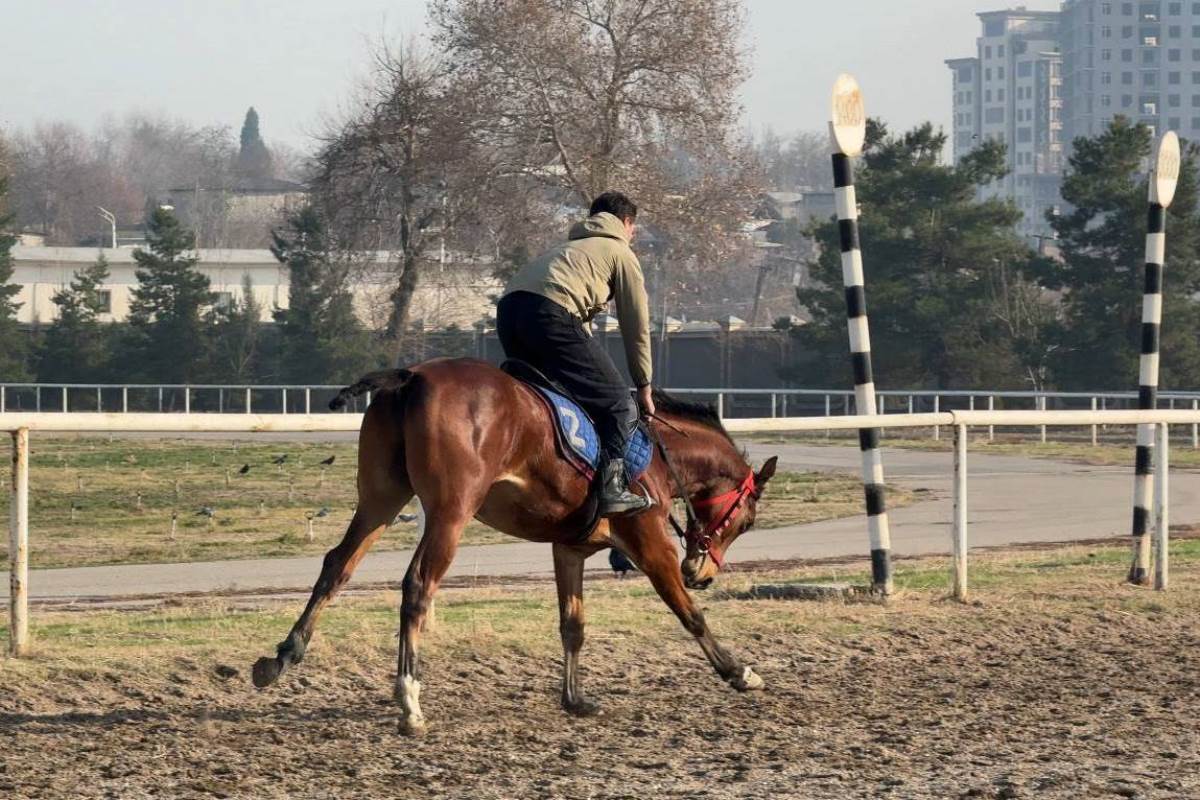
“A jockey should weigh no more than 52 kilograms,” he explains. That’s not just a rule — it’s essential. The rider must lift the horse, not drag it down.
A jockey isn’t just a passenger. It’s someone who feels the horse — its energy, mood, and signals. “Most important thing is to love the horse,” he says without drama. And somehow, that simple truth feels more powerful than any technical advice.
Intelligence and personality in every glance
The moment we stepped into the stable, we could sense the horses’ awareness. “They’re very intelligent and sensitive,” says Mirasil. “When a stranger enters, they get uneasy. They need time to get used to you. But they always recognize their own.”
And indeed — at first, some horses stared cautiously, some snorted, others stepped back. But within minutes, the tension faded. They allowed themselves to be photographed, as if they understood we meant no harm.
“Each one has its own personality,” Mirasil adds. “Some are curious, others shy, a few distant. It’s not just about the breed — much depends on the horse itself.”
They introduce us to a “troublemaker” — a stallion who expresses dissatisfaction in his own way. “If you’re five minutes late with food or water, he starts jumping, and he’s broken the stall more than once,” says Sadriddin with a chuckle.
All the shades of red
The stable is filled with color. We saw turuks, jirans, bay horses — shades and tones that experienced horsemen speak of like a language all its own.

Sadriddin explains it simply: there are four primary coat colors — bay, chestnut, gray, and black. Everything else is a variation. Here, turuks and jirans are most common — various shades of bay and chestnut.
And while color doesn’t define personality, each horse seems to wear its coat like an identity — like a name or a passport. No random hues — everything feels alive, real, and uniquely beautiful.
We came looking for a fiery-red horse — the kind tied to the poetic name Aspi Otashin, the Red Fire Horse. We didn’t find it.
But leaving the stable, we realized: a symbol doesn’t have to be a color. A symbol is what stays with you — the warmth of the zagir cooking, the neat cart of barley, the trainer’s calm hands, and the eyes of the horses — intelligent, diverse, alive.
Year of the Horse: Chinese dates and the Tajik mujal
The year 2026 is the Year of the Horse. But in the Eastern calendar, it begins not on January 1st, but mid-February. According to the Tajik mujal system, the new year starts with Navrouz, on March 21, 2026. Until then, it remains the Year of the Snake.
Tajik mujal (or Munjal, meaning 'annual horoscope') refers to the Tajik system of astrology, a Persian-influenced branch of Vedic astrology focusing on annual predictions using the Solar Return Chart (Varshphal) for yearly insights into career, health, etc., using special techniques like Sahams and unique planet/house genders, unlike standard Vedic astrology's focus on birth charts.
In "Solnoma" (“Chronicle”) by Hakim Termizi, it is written that the Year of the Horse will bring an abundance of grain, vegetables, and fruits.
These are the hopes with which we welcome the coming year.
 Руcский