




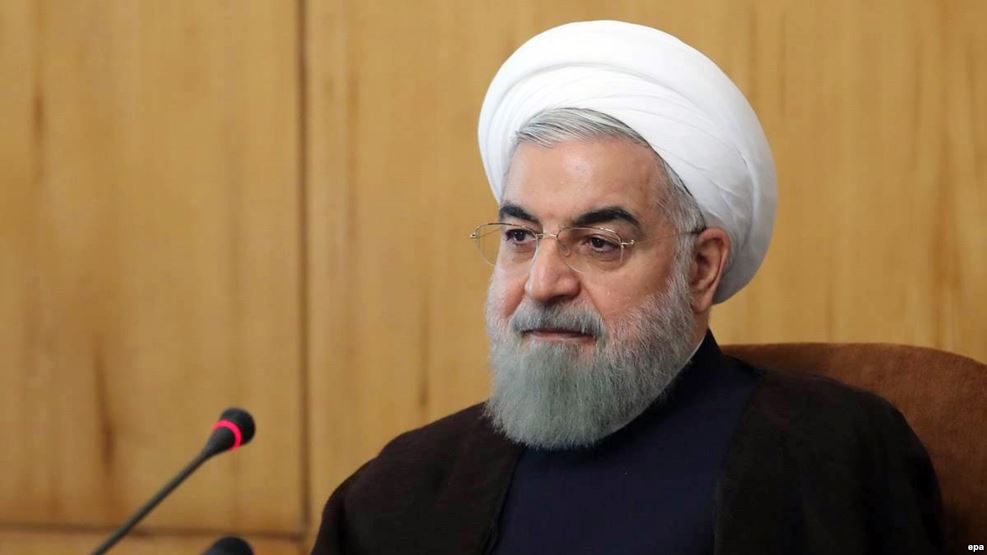
High-ranking Iranian state officials urge that U.S. President-elect Donald Trump should stay committed to the international nuclear deal with Iran.
“Iran's understanding in the nuclear deal was that the accord was not concluded with one country or government but was approved by a resolution of the UN Security Council,” Iranian President Hassan Rohani said on state television. “There is no possibility that it can be changed by a single government.”
Iranian Foreign Minister Mohammad Javad Zarif, who was Tehran's lead negotiator for the Joint Comprehensive Plan of Action (JCPOA -- the nuclear deal), echoed Rohani's statement that Trump must remain committed to the deal.
“Every U.S. president has to understand the realities of today's world,” Zarif was quoted as saying by the Tasnim news agency.
“The United States should fulfill its commitments in the Joint Comprehensive Plan of Action as a multilateral international agreement,” Zarif was quoted as saying while on a visit to Romania.
The spokesman of the Atomic Energy Organization of Iran, Behrouz Kamalvandi, was quoted as saying by Tasnim news agency: “Iran is prepared for any change,” adding that Iran would try to stand by the deal.
In Washington, White House spokesman Josh Earnest told reporters on November 9 that the outgoing administration remained committed to the nuclear deal.
“This administration will be committed to implementing those policies through January 20, and we will live up to the commitments that we have made in each of those areas as we do so,” he told reporters.
Meanwhile, some characterized Trump’s election as a death knell for the deal, which was reached in 2014 and put into effect in January. It imposes limits on Iran’s nuclear program and its ability to build atomic weapons for at least 10 years in exchange for lifting most international sanctions.
“I think it’s basically the end game for the deal,” said Richard Nephew, a Columbia University fellow who was the lead sanctions expert on the U.S. negotiating team, according to The Washington Post.
“The big winner in the aftermath of a Trump victory is Iran’s Supreme Leader,” Suzanne Maloney, a foreign policy expert at the Brookings Institution, was cited as saying by Reuters.
“He will have the most cartoonish American enemy, he will exult in the (hopefully brief) crash of the American economy, and he will be able to walk away from Iran’s obligations under the JCPOA while pinning the responsibility on Washington.”
The Jerusalem Post reports that during his campaign, Trump expressed his opposition to the nuclear deal reached last year between Iran and worlds powers.
Trump has reportedly called the Iran nuclear deal one of the worst deals in history.
Laying out his campaign's closing argument last Wednesday, Trump advisers wrote that he would “counteract Iran’s ongoing violations of the Joint Comprehensive Plan of Action regarding Iran’s quest for nuclear weapons and their noncompliance with past and present sanctions as well as the agreements they signed, and implement tough, new sanctions when needed to protect the world and Iran’s neighbors from its continuing nuclear and non-nuclear threats,” according to The Jerusalem Post.


Tajikistan’s health ministry denies claims linking Pantogam drug to child deaths
What risks an abnormally warm winter poses to Tajikistan
Tajikistan’s capital ranks among cities with the lowest cost of living worldwide
Why is Tajik honey not exported to Europe?
Around 400 new industrial enterprises launched in Tajikistan in 2025
Tajikistan implements licensing system reform
Emomali Rahmon signs decree to increase salaries, pensions, and scholarships
Iran closes airspace amid fears of US strikes
US suspends immigrant visa processing for 75 countries
Tajikistan launches its first large-scale solar energy project
All news
Авторизуйтесь, пожалуйста