




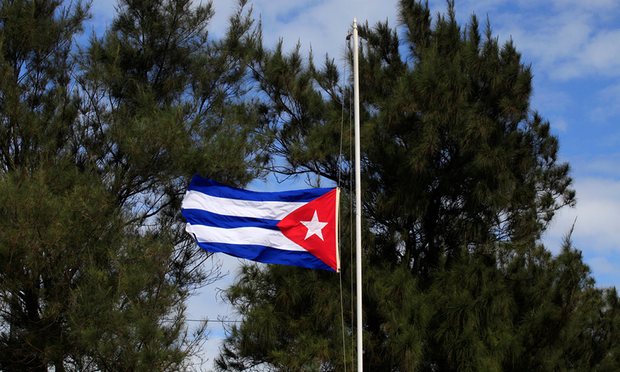
Fidel Castro, the Cuban revolutionary who built a communist state on the doorstep of the United States and for five decades defied U.S. efforts to topple him, died on Friday November 25. He was 90.
A towering figure of the 20th century and Cold War icon, Castro stuck to his ideology beyond the collapse of Soviet communism and remained widely respected in parts of the world that struggled against colonial rule, according to Reuters.
Castro had been in poor health since an intestinal ailment nearly killed him in 2006. He formally ceded power to his younger brother, Raul, two years later.
A mix of tributes and condemnation poured in from around the world.
In a telegram to Raul Castro cited by the Kremlin, the Russian President, Vladimir Putin, said: “The name of this distinguished statesman is rightly considered the symbol of an era in modern world history … Fidel Castro was a sincere and reliable friend of Russia.”
According to The Guardian, the French President, Francois Hollande, mourned his loss but noted concerns over human rights under the Castro regime. “Fidel Castro was a towering figure of the 20th century. He incarnated the Cuban revolution, in both its hopes and subsequent disillusionments,” he said.
Pope Francis also sent Raul Castro his condolences in a telegram. “I express my sentiments of sorrow to your excellency and other family members of the deceased dignitary, as well as to the people of this beloved nation,” the telegram read. “At the same time, I offer prayers to the Lord for his rest and I trust the whole Cuban people to the maternal intercession of our Lady of the Charity of El Cobre, patroness of this country,” he says.
“History will record and judge the enormous impact of this singular figure on the people and world around him,” U.S. President Barack Obama said, extending “a hand of friendship” to Cuba.
Meanwhile, Obama’s elected successor, Donald Trump, said he would work to ensure the Cuban people “can begin their journey toward prosperity and liberty,” even though “the tragedies, deaths and pain caused by Fidel Castro cannot be erased.”
“The death of Fidel Castro is a loss to both the Cuban nation and the humanity. Apart from stance on this person, its scale was of world-wide historic importance and had a real impact on the world's history. Such things could be said not about every politician," the chair of the Foreign Affairs Committee of Russia’s upper house (Federation Council) of parliament, Konstantin Kosachev told RIA Novosti.
He added that the name of the Cuban politician would be in the history of humanity forever.
Fidel Castro was born in 1926 in the Cuban village of Biran. He became Cuban prime minister in February 1959. In 2008, he announced his resignation as head of state. He remained the first secretary of the Cuban Communist Party until April 19, 2011, when he officially announced his resignation from the post.
Cuba has declared nine days of national mourning to mark the death of Fidel Castro. On Saturday, the Cuban government announced Castro’s ashes would be interred at the Santa Ifigenia cemetery in Santiago de Cuba on 4 December. The cemetery is the resting place of 19th-century Cuban independence hero Jose Marti and numerous other leading figures in the country’s torrid history.


Tajikistan ratifies agreement with Kyrgyzstan on mutual stay of citizens
Iranian Embassy flag in Dushanbe lowered in mourning
Kidnapping of former Dushanbe prosecutor’s son solved after 25 years
Will Tajikistan take part in the 2026 Winter Olympics in Italy?
Iran protests seen as most serious challenge to Islamic Republic in years
A bill on annexation Greenland reportedly introduced in the US Congress
Radio frequency fees in Tajikistan increase hundreds of times
Heat purchase rates in Dushanbe to rise by 17%: will heating costs increase for households?
Radio Ozodi reports another Tajik citizen killed in the war in Ukraine
Noisy teen party disrupted in Dushanbe: knives seized, fines imposed
All news
Авторизуйтесь, пожалуйста