




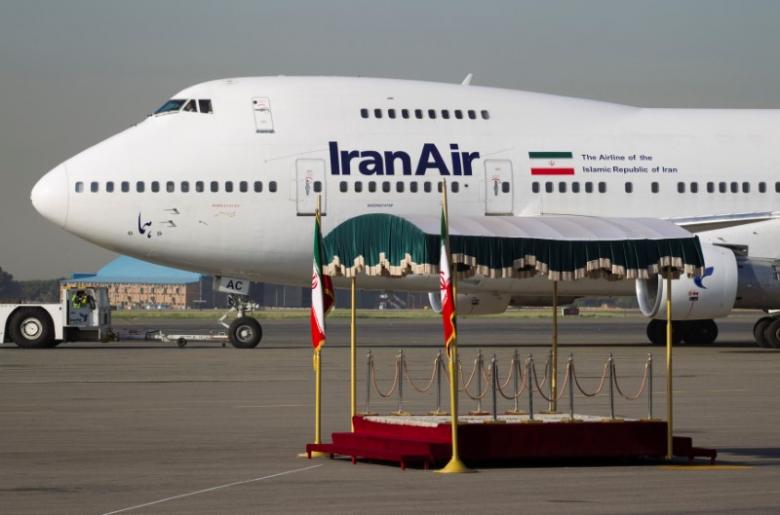
Iran's state-run IRNA news agency reports that Iran’s flag air carriers, Iran Air, and the American Corporation of Boeing on December 11 signed an agreement on selling 80 aircraft to Iran.
The agency quoted Farhad Parvaresh, the chairman of Iran's flag carrier, as saying that the 10-year deal included 50 Boeing 737 aircraft and 30 777 planes.
IRNA said that Fletcher Barkdull, a Boeing regional director, was in Tehran for the signing ceremony. The agency quoted Barkdull as saying that the deal was worth $16.6 billion and had been approved by the U.S. government.
The Associated Press reports that Iran Air's deal for 80 jetliners is the biggest agreement Iran has struck with an American company since the 1979 revolution and U.S. Embassy takeover. It reportedly has the potential to transform Iran's creaking and accident-prone aviation industry, which has been hobbled by years of sanctions.
Those curbs have prevented the country from buying new planes from Chicago-based Boeing and European rival Airbus, and in many cases made it difficult for Iranian airlines to secure much-needed spare parts.
The deal covers 50 single-aisle 737 Max 8s, a soon-to-be-introduced version of Boeing's existing narrow-body 737 line.
It also includes 30 777s, a wide-body, twin-engine plane typically used on long-haul routes. Half of the order will cover the 777-300ER version, while the rest will be of the 777-9 model still under development.
Iran's state-run IRNA news agency said the planes would be delivered over the next decade. The first will start to arrive in 2018, Boeing said.
In September, Washington granted permission to Boeing and Toulouse, France-based Airbus to sell billions of dollars' worth of aircraft to Iran. Airbus needed U.S. approval because at least 10 percent of its planes' components are of American origin.
According to the Associated Press, the U.S. and other world powers agreed last year to lift crippling sanctions on Iran in exchange for it curbing its nuclear activities. The U.S. still maintains extensive sanctions on Iran for activities unrelated to its nuclear program.
President-elect Donald Trump and several Republican lawmakers have criticized the nuclear deal, but it's unclear whether they would scrap the agreement, which was reached with Britain, France, Germany, Russia and China.
The Republican-led House of Representatives last month voted to bar commercial aircraft sales to Iran in a move that could block the Boeing deal. That legislation must still pass the Senate, where it will likely face opposition from Democrats. U.S. President Barack Obama has said he will veto the bill if it reaches his desk before he leaves office on January 20, 2017.
Boeing made a point of saying it worked closely with the U.S. government throughout the deal-making process and will continue to “follow all license requirements.” The Iran Air deal “will support tens of thousands of U.S. jobs” linked to the 777s alone, it said.


Tajik labor minister outlines key mechanisms for protecting labor migrants
Tajikistan’s grand mufti proposes establishing a Waqf Authority to regulate charity
Only two settlements renamed in Tajikistan in 2025
Mine action as a humanitarian challenge in Azerbaijan
Moscow Metro introduces selective checks of passengers’ mobile phone
Barqi Tojik promises additional hours of electricity supply during the holy month of Ramadan
Tcell receives government recognition for tax compliance
Tajikistan raises tariffs for drinking water and communal services
FAO to support sustainable apricot production in Tajikistan
Religious organizations in Tajikistan donate more than 11.2 million somoni to charity
All news
Авторизуйтесь, пожалуйста