




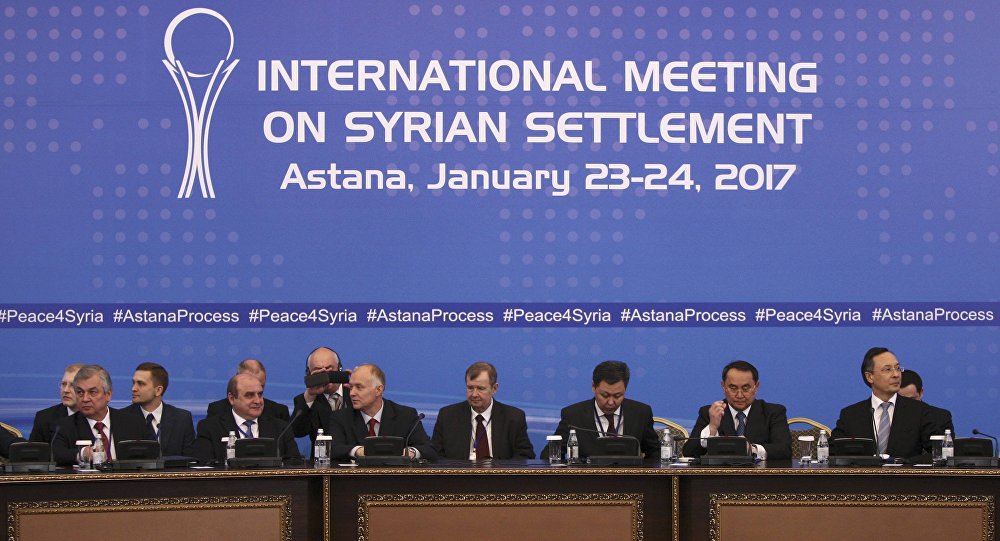
The first day of talks aimed at solidifying the cease-fire in Syria’s civil war has reportedly ended in Astana, Kazakhstan with no breakthroughs.
Delegations from both the Syrian government and the opposition participated in the sessions on January 23 but did not address one another directly.
Yahya al-Aridi, the spokesman for the Syrian opposition at the talks, said his group met with the Russian and Turkish delegations in the presence of UN envoy to Syria Staffan de Mistura to discuss details of a nationwide cease-fire.
Alexander Lavrentyev, the special representative of the Russian president at the talks, said the “intensity of emotions was rather high" but that the government representatives and the opposition delegation "refrained from any abrasive actions toward each other,” Interfax reported.
“We think that the first day was rather successful,” he added.
The talks between the Syrian and armed opposition groups underway in the Kazakh capital should serve as an important step in the crisis settlement, Russian Foreign Minister Sergei Lavrov was cited as saying by Sputnik.
Russia's focus in Astana is to engage Syrian armed opposition groups, but political groups are not excluded from the process, Lavrov said.
The Syrian government and the armed opposition are negotiating behind the closed doors. Damascus delegation is set to speak first, followed by the armed opposition, Russia, Iran, Turkey, the United States and the United Nations.
In their opening statements, the two sides differed markedly in their interpretation of the purpose of the current cease-fire. Government delegation head Bashar al-Jaafari said it was needed to separate those opposition groups interested in "the political process" from those affiliated with Islamic State or Al-Qaeda.
Opposition spokesman Muhammad Allush said the cease-fire should be the first step toward a political settlement “involving the departure of President Bashar al-Assad and the ruling gang.” Allush also called for Iranian forces and Iran-backed militias to leave Syria.
Allush called for putting foreign militias fighting alongside Assad's army on the list of terrorist organizations. He said such groups include Lebanon's Hizballah.
He added that Syrian civilians were facing two forms of terror: “the terrorism of Bashar Assad” and the "terrorism of [Islamic State],” The Associated Press reported.
The talks are being facilitated by Russia, Iran, and Turkey, and are being monitored by the U.S. ambassador to Kazakhstan and the UN special envoy on Syria, Staffan de Mistura.
De Mistura told Interfax that he was optimistic the cease-fire can be secured throughout Syria if the parties can agree to a monitoring mechanism. He called for both sides to renounce the use of military means.
The talks are primarily aimed at bolstering a cease-fire agreement reached in December and at advancing the conflict-resolution process that has been proceeding in Geneva under UN auspices. The next session of the Geneva talks is set for February 8.


Tajik MMA fighter killed in Teen Brawl in Kulob
Tajik citizens invited to work in South Korea under the EPS TOPIK system
New electricity rates in Tajikistan: what consumers will pay from February 1,2026
Tajikistan cuts fruit exports to Kazakhstan in 2025
Cost of Hajj for Tajik citizens drops by nearly 4,000 somonis in 2026
President Rahmon makes personnel changes in Tajikistan’s judiciary system and foreign ministry
Growing glacier discovered in the Pamirs, defying global warming trends
How food prices in Tajikistan changed over the past year
Attempt to smuggle medicines worth over 1 billion soums from Uzbekistan to Tajikistan Foiled
IOM warns Tajik citizens of job scams linked to employment in the UK
All news
Авторизуйтесь, пожалуйста