




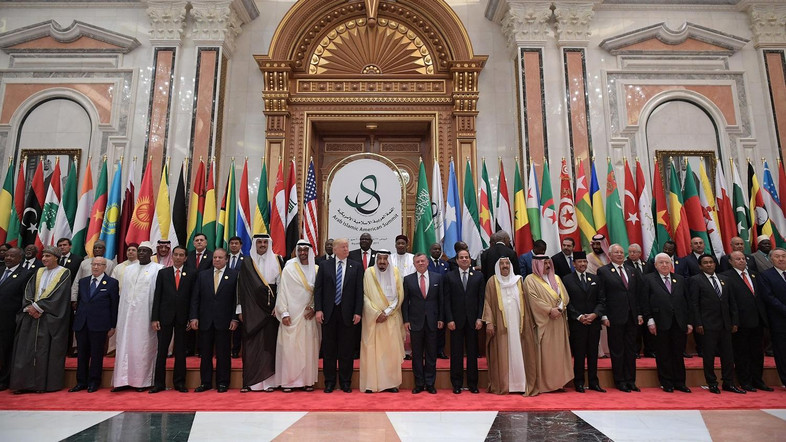
Emomali Rahmon was among leaders invited to the US-Arab Islamic summit in Riyadh
Leaders, Jordan, Algeria, Niger, Yemen, Morocco, Turkey, Pakistan, Iraq, Tunisia, Afghanistan and some other Muslim countries, in all, leaders of more than 50 Muslim countries, have received invitations to attend the US-Arab Islamic summit in Riyadh.
According to media reports, the Summit in Riyadh provided an opportunity for the participating countries to discuss how to overcome the menace of terrorism and extremism across the world. The Summit delinked ‘terrorism’ from any particular religion, culture, civilization or region.
Saudi King Salman and US President Trump gave keynote addresses at the US-Arab-Islamic Summit.
Trump addressed the threat of terrorism facing the world directly, showing that the United States stands with its allies to rid the world of this evil. “America is prepared to stand with you – in pursuit of shared interests and common security. But the nations of the Middle East cannot wait for American power to crush this enemy for them. The nations of the Middle East will have to decide what kind of future they want for themselves, for their countries, and for their children."
President Trump, in particular, called for Muslim leaders to “drive out” terrorism from their countries.
Saudi Arabia -- which is home to Islam's holiest sites – was Trump's first foreign stop since becoming president in January.
According to ABC News, Trump arrived in Riyadh, Saudi Arabia’s capital, on May 20. After arriving in Riyadh, Trump had coffee with King Salman of Saudi Arabia, attended a royal banquet and held bilateral meetings with the king, the crown prince and the deputy crown prince.
On May 21, Trump held bilateral meetings with Gulf Cooperation Council leaders as well as broader meetings with all Gulf states leaders.
Trump participated in the inauguration of a new center to fight radicalism and promote moderation.
Critics have accused Trump of being anti-Muslim after he issued a ban, now blocked by U.S. courts, on entry into the United States by citizens of several Muslim-majority countries, citing national security concerns. Recall, U.S. President Trump signed in January an executive order banning entry of citizens from seven Muslim-majority states over security threats. He downsized them to six later in March, including Syria, Yemen, Libya, Somalia, Sudan and Iran, excluding Iraq from the previous list.


Why digital assets are increasingly impacting financial everyday life
Uzbekistan plans mirror economic measures against Tajikistan
Mass fight among teenagers prevented in Dushanbe
The secrets of the Blue Fortress Glacier: How the Pamirs help us understand climate change
MISiS Branch and Confucius Institute at TNU sign cooperation agreement for Chinese language studies
Tajikistan's economy grows by 8.4% in 2025: what’s driving the growth?
ADB to support floating solar systems in Tajikistan
China expands investments and business in Central Asia
Tajikistan plans to introduce mandatory health insurance after 2030
A native of Tajikistan arrested after killing of 18-Year-old guy n in Elektrostal, Moscow region
All news
Авторизуйтесь, пожалуйста