




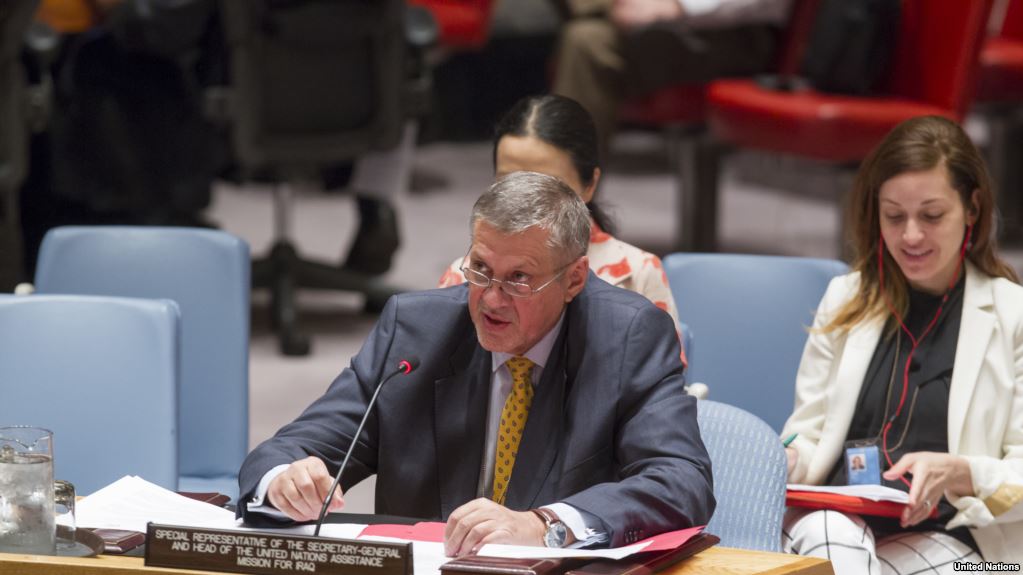
The United Nations envoy for Iraq told the UN Security Council on May 22 that the liberation of the northern Iraqi city of Mosul “is imminent” and the days of the Islamic State extremist group's self-declared caliphate “are numbered”, according to the Associated Press (AP).
But Jan Kubis noted that despite progress, fighting remains “a tremendous challenge” because IS militants are increasingly using civilians as human shields in “a last-gasp effort that reveals little more than the inherent inhuman barbarity of the terrorists.”
He credited “the bravery and patriotism of the Iraqi security forces, including the popular mobilization forces, the [Kurdish] peshmerga, and the tribal volunteers, as well as the endurance of the Iraqi people.”
Iraqi forces, backed by a U.S.-led coalition, officially launched the operation to retake Mosul, the country's second-largest city, in October. The city's east was declared "fully liberated" in January and the fight for the west was launched the following month. It has been marked by some of the most grueling and deadly combat in the fight against IS in Iraq to date.
The territory controlled by IS militants in west Mosul has reportedly been reduced to eight square kilometers, but the area includes the Old City, where the heaviest fighting of the campaign is likely still to come.
IS militants captured Mosul in 2014 as they gained wide swathes of territory in Iraq and Syria in battles against government troops.
Kubis said military operations in Iraq are shifting to the remaining areas and pockets where IS extremists are still present. Prime Minister Haider al-Abadi has announced that the next steps are to secure the Iraq-Syria border and to liberate west of Ninewa and Anbar governorates, the UN envoy said.
"Although large-scale military operations against ISIL will hopefully conclude by the end of this year, the security environment will remain volatile and will be characterized by continued cowardly terrorist attacks by Daesh, targeting civilians in many parts of the country," he said.
Kubis said a dual focus must be maintained on the immediate challenges of defeating IS extremists and on preparing for the liberation, stabilization and rehabilitation of Iraq.
In addition, he said, "the imminent defeat of Daesh provides an urgent impetus to address the concerns of minorities ... (who) continue to face existential challenges and need special attention" so they can return home.
The Islamic State's “caliphate,” declared after the June 2014 military campaign, once stretched across northern Syria through much of northern and western Iraq. But the group, also known as ISIL and Daesh, is now under attack in both countries and the territory it controls has shrunk.


Registration of pensioners in Tajikistan via Face ID system extended?
Artist from Asht revives fairytales by painting on stones
Woman arrested for attempting to sell her 8-month-old baby
Tajikistan to introduce new professional holiday
Why doesn't Tajikistan process leather?
Migrant workers in Samara region will be banned from working as couriers and janitors
44 Uzbek citizens deported from the United States this month
Uzbek national sentenced to life in prison for murder of Russian general
Eggs, fruit and meat: Tajikistan’s top agricultural products in 2025
EBRD to allocate €10 million for electric buses in Khatlon province
All news
Авторизуйтесь, пожалуйста