




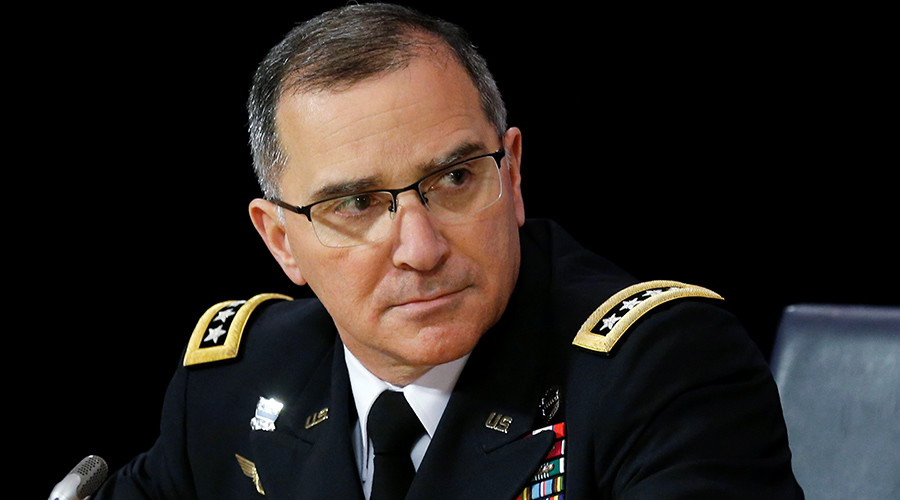
Media reports say the top U.S. military commander in Europe again backed sending more advanced weaponry to Ukraine to help it in its fight against Russia-backed separatists
Washington must do more to deter "Russian aggression," including sending lethal weapons to the government in Ukraine and engage in information warfare across the board, General Curtis M. Scaparrotti, head of the US European Command (EUCOM), told lawmakers on March 28.
“I personally believe that we need to consider lethal defensive weapons for Ukraine," Scaparrotti told the House Armed Services Committee on Tuesday.
“I haven't discussed that specific issue with most of our partners," Scaparrotti admitted when he was asked about the NATO allies' opinion on arming Kyiv. The general is also the NATO Supreme Allied Commander in Europe (SACEUR).
“Russia seeks to undermine this international system and discredit those in the West who have created it,” Scaparrotti argued in his opening remarks, calling for "demonstrating strength in every area" when it comes to dealing with Moscow.
He also accused Russia of threatening every country in its vicinity, stoking ethnic tensions in the Balkans, "complicating" US operations against Islamic State (IS, formerly ISIS/ISIL) in Syria and violating the Intermediate-Range Nuclear Forces (INF) Treaty by deploying land-based cruise missiles.
Russia’s RT news agency says that at the hearing on Tuesday, Scaparrotti and the lawmakers were of the same mind that Russia was an adversary and a threat in every respect. In addition to arming the government in Ukraine and building up the US military presence in Europe, the general advocated information warfare as well.
“Going forward, we must bring the information aspects of our national power more fully to bear on Russia, both to amplify our narrative and to draw attention to Russia's manipulative, coercive, and malign activities,” he said.
The administration of then-President Barack Obama sent Ukraine flak jackets, night-vision goggles, and other equipment. But officials resisted calls, in Congress and elsewhere, to send “lethal defensive weaponry” such as Javelin antitank missiles, fearing that would invite escalation from Russia.
Obama's successor, Donald Trump, has spoken of a more conciliatory approach toward Russia since his election, but has made no indication one way or another if more serious weaponry was under consideration.
According to Radio Liberty, some of his cabinet members, including Defense Secretary Jim Mattis, have made pointed comments indicating a tougher approach to Moscow than Trump himself has espoused.

Happy New Year, friends!
The horse spirit of Tajikistan: from ancient bloodlines to modern champions
International education in Central Asia: how UCA opens the door to a global career
EcoCars: how a company with Tajik roots became one of China’s first official EV exporters
Barqi Tojik promises uninterrupted power supply during New Year holidays
Emomali Rahmon extends New Year greetings to the people of Tajikistan
Sharif Nazarov, a pillar of Tajik football, passes away at 79
Winter Recreation in Tajikistan: where to recharge and enjoy nature
Three-year-old child dies after beating in Fayzobod district; stepmother suspected
Tajikistan expands list of officials required to declare assets and income
All news
Авторизуйтесь, пожалуйста