




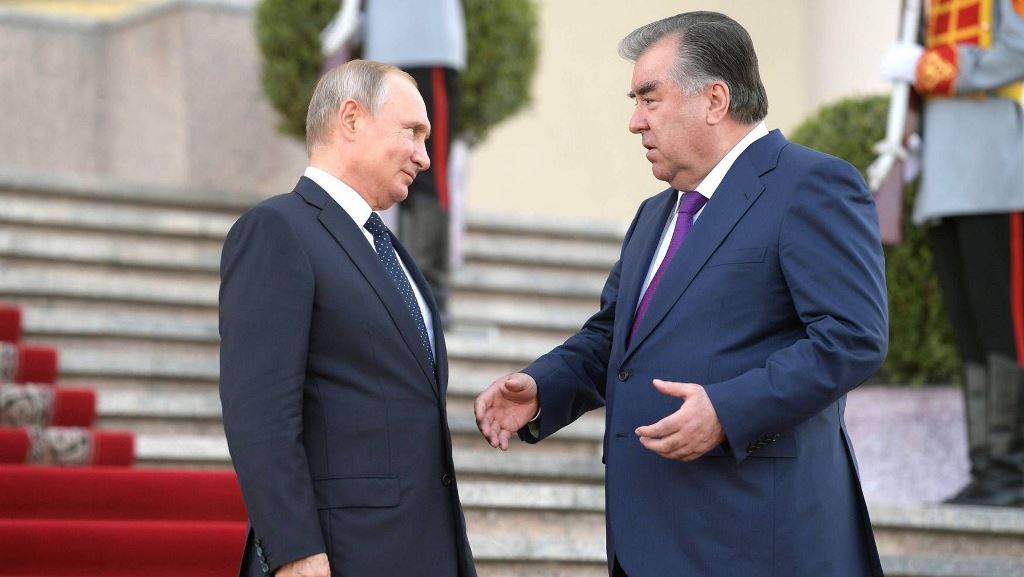
Russian President Vladimir Putin will arrive in Tajikistan on October 9 for his first-ever state visit to the country. The trip is timed to coincide with the meeting of the CIS Heads of State Council, which will take place in Dushanbe on October 10, according to official sources.
This visit marks a historic moment in bilateral relations: although Putin has traveled to Tajikistan 12 times during his presidency, this will be the first visit with state-level status — the highest category of diplomatic visit.
A longstanding diplomatic record
Over his more than two decades in power, Putin has made Tajikistan one of the most frequently visited destinations in the post-Soviet space.
By number of visits, Tajikistan ranks eighth among all countries visited by the Russian leader — behind Kazakhstan (33 visits), Belarus (28), Ukraine (21), China (20), Germany (18), France (17), and Kyrgyzstan (15).
Until now, Putin had paid four official and eight working visits to Tajikistan. A state visit, however, is a different category altogether: it is the highest form of diplomatic engagement, typically occurring once during a head of state’s tenure to emphasize a strategic partnership.
By contrast, an official visit signifies formal cooperation but with less ceremony, while a working visit is focused on specific negotiations or participation in multilateral events.
For context, former President Boris Yeltsin never visited Tajikistan during his nine years in office (1991–1999), while Dmitry Medvedev made three official visits between 2008 and 2012 — in August 2008, July 2009, and September 2011.
Putin’s frequent travels to Dushanbe reflect the depth and intensity of Russian–Tajik relations, which have remained consistently close in the military, security, and migration spheres.
Putin’s visits to Tajikistan by presidential term
First Presidential Term (2000–2004)
- July 5, 2000 – Working Visit. Putin’s first trip to Tajikistan included talks with President Emomali Rahmon and a meeting with Chinese leader Jiang Zemin. He also attended the summit of the “Shanghai Five”, the precursor to the Shanghai Cooperation Organization (SCO).
- October 22, 2001 – Working Visit. In Dushanbe, Putin met with Rahmon and Afghan President Burhanuddin Rabbani. Following the trilateral talks, the three leaders issued a joint declaration on cooperation amid post-war instability in Afghanistan.
- April 26–28, 2003 – Working Visit. Putin took part in the Eurasian Economic Community (EurAsEC) Interstate Council and the Collective Security Treaty Organization (CSTO) summit. He also visited Russia’s 201st Motor Rifle Division, stationed in Tajikistan.
During the visit, the two foreign ministers signed a protocol on ratifying the Double Taxation Avoidance Agreement (1997) and a program of cooperation between the Russian and Tajik foreign ministries.
Second Presidential Term (2004–2008)
- October 16–17, 2004 – Official Visit. Putin’s first official visit to Tajikistan marked a turning point in security cooperation. The sides signed key agreements defining the new format of Russia’s border presence, the status of its military base, and the handover of the Tajik–Afghan border to Dushanbe’s control. A total of 14 documents were signed, and the two leaders inaugurated the 201st Russian Military Base.
- October 5–6, 2007 – Working Visit. Putin attended meetings of the CIS, EurAsEC, and CSTO councils of heads of state. He also held talks with President Rahmon on bilateral political and economic cooperation, citing the construction of the Sangtuda-1 Hydropower Plant as a positive example of partnership.
Third Presidential Term (2012–2018)
- October 2012 – Official Visit. Putin’s second official visit to Tajikistan resulted in the signing of a major agreement on the status and conditions of Russia’s military base in the country, extending its presence until 2042. In total, six new documents were signed, covering cooperation in defense, education, and migration policy.
- September 11–12, 2014 – Official Visit. Putin attended the Shanghai Cooperation Organization (SCO) summit in Dushanbe, where SCO member states adopted the Dushanbe Declaration. On the sidelines, he held talks with President Rahmon on regional security and bilateral ties.
- September 14–15, 2015 – Working Visit. The Russian leader participated in the Collective Security Treaty Organization (CSTO) summit, where a package of security documents was approved, including a Joint Statement of the CSTO Heads of State. Putin and Rahmon also discussed economic and migration issues during separate bilateral talks.
- February 27–28, 2017 – Official Visit. During this visit, Putin and Rahmon discussed expanding trade, investment, and cultural cooperation, as well as collaboration in science and education.
The sides signed seven agreements, including one on peaceful use of nuclear energy and another on labor and employment cooperation.
Fourth Presidential Term (2018
September 27–28, 2018 – Working Visit. Putin attended the CIS Heads of State Council meeting in Dushanbe and held bilateral discussions with Rahmon
June 14–15, 2019 – Working Visit. He took part in the Conference on Interaction and Confidence-Building Measures in Asia (CICA) and met with Emomali Rahmon and Qatar’s Emir Tamim bin Hamad Al Thani.
June 28, 2022 – Working Visit. Putin met with Rahmon for talks on strategic partnership and regional security, including developments in Afghanistan. This visit was Putin’s first foreign trip since the start of Russia’s full-scale military operation in Ukraine, underscoring the symbolic importance of Tajikistan in Moscow’s regional diplomacy.
Putin’s promises: what has been fulfilled and what has not
Fulfilled
Modernization of the 201st Military Base. Putin and Rahmon agreed to extend the presence of the Russian 201st military base in Tajikistan until 2042. Under this agreement, Moscow committed to modernizing the base and providing weapons, training, and technical support. Modernization began in 2014, and by 2021, Russia had completed deliveries of new air-defense systems as part of ongoing military-technical cooperation.
- Support for border security. Russia has consistently assisted Tajikistan in strengthening its border with Afghanistan, supplying military equipment and intelligence, and conducting joint military drills. For example, in 2021, more than 3,000 troops took part in large-scale exercises under the “Center-201” program.
- Migration amnesty. In 2020, approximately 130,000 Tajik citizens regained the right to work legally in Russia under a migration amnesty announced by the Russian authorities.
Partially fulfilled
- Hydropower development. Russia pledged support for Tajikistan’s hydropower projects. However, only Sangtuda-1 hydropower plant (HPP) has been completed — launched in 2009 with Russian participation. An earlier agreement between the Tajik government and RUSAL (2004) to co-finance the Roghun HPP collapsed due to disagreements over key conditions. Today, most of Roghun’s funding comes from domestic and international sources, not from Russia.
- Support for Labor Migrants. Russia introduced a patent-based system for foreign workers, intended to simplify employment procedures. Yet, bureaucratic obstacles remain: in 2021, about 40% of Tajik migrants reportedly faced problems obtaining work patents due to high costs and complex procedures.
Unfulfilled
- Economic modernization. Despite multiple statements of intent, Russia’s promised industrial and transport investments in Tajikistan have largely failed to materialize. Projects such as railway modernization and mining sector development never advanced beyond initial proposals.
Moscow’s focus in bilateral relations has increasingly shifted toward security, migration, and defense, rather than economic transformation. - Agricultural cooperation. Moscow also pledged to support Tajikistan’s agricultural sector, but real progress has been limited to minor trade agreements — such as the 2015 deal allowing Tajik fruit and vegetable exports to Russia.
Many initiatives stalled amid bureaucratic barriers and lack of funding, and state-backed agricultural credit programs never expanded as planned.
Conclusion
Over two decades of Vladimir Putin’s presidency, Russia has provided Tajikistan with significant military and security assistance, helping to reinforce border stability and defense capacity.
However, many of the economic and development promises remain unfulfilled.
Moscow’s engagement with Dushanbe has become increasingly defined by security, migration, and military cooperation, while economic diversification and large-scale investment have taken a back seat.
 Руcский
